Sending more applications can feel like the only available response to silence. Before you increase the volume, examine where your current approach may be breaking down. The problem might involve the roles you choose, the evidence in your application, restrictions you missed, or a search that depends on one source. Some decisions will remain outside your control.
A useful review ends with one change you can test. It does not require you to reinvent your career after every rejection.
Start with applications that have had time to progress
Review a recent group of applications and record when you applied, the role, how closely it matched your experience, and the latest status. Keep pending applications separate from confirmed rejections. A submission from yesterday is not evidence of a failed approach.
Separate recruiter conversations from later interviews. If you receive no initial conversations, examine targeting and application clarity first. If conversations happen but do not progress, review what the employer needed and what you communicated. These are hypotheses to investigate, not automatic explanations.
Check eligibility before judging your resume
Look for explicit requirements such as location, work authorization, professional credentials, working hours, or travel. A remote position may still restrict where someone can work. Do not assume that enthusiasm or transferable skills can replace a mandatory license.
Then identify the work itself. Could you explain, with examples, how you would handle the role’s central responsibilities? If most of your applications depend on a recruiter inferring a major career transition, your materials may need a clearer bridge.
Make your evidence easy to find
Imagine a fictional coordinator applying for an operations role. Their resume opens with “motivated professional seeking growth,” but the employer needs someone to manage schedules, resolve handoff problems, and maintain accurate records.
The coordinator actually does those tasks. The issue is visibility. A more useful opening could be: “Operations coordinator with experience scheduling service teams, resolving work-order discrepancies, and maintaining customer records.” The following bullets should substantiate those claims.
Highlight relevant evidence near the top. Keep your official titles and dates accurate. Do not add expertise simply because it appears in the posting.
Review your search sources
If every application comes from the same broad job-board search, add a different route: a shortlist of employers, a specialist professional community, or a conversation with someone who knows your work. A referral is not a guarantee, and a new source is not automatically better. The purpose is to avoid relying on one narrow view of the market.
Use this diagnostic
| Question | Evidence to inspect | Possible next step |
|---|---|---|
| Am I eligible? | Location, credentials, schedule | Remove mismatched roles |
| Can I do the central work? | Three real examples | Narrow the target or explain the transition |
| Is that evidence visible? | Summary and relevant bullets | Rewrite for clarity |
| Are applications complete? | Submitted files and required fields | Correct omissions |
| Am I relying on one source? | Application-source history | Add one relevant source |
Choose the strongest supported issue. For two weeks, change that part of your process and note what happens. The sample may be too small for a firm conclusion, but it can still reveal whether your search is becoming more focused.
Work through one application, line by line
This fictional example shows a review method, not a successful application or a promise of interviews. The role asks for scheduling, work-order accuracy and communication with service teams. The candidate has done those tasks but has no verified performance numbers.
- Copy the three responsibilities into a private worksheet. Keep mandatory eligibility requirements in a separate first check. An attractive writing sample cannot resolve an unmet requirement.
- Match each responsibility to one true example. For scheduling, the candidate maintains a weekly rota. For accuracy, they compare work orders with the booking record. For communication, they confirm changes with technicians. Mark a missing example as a gap.
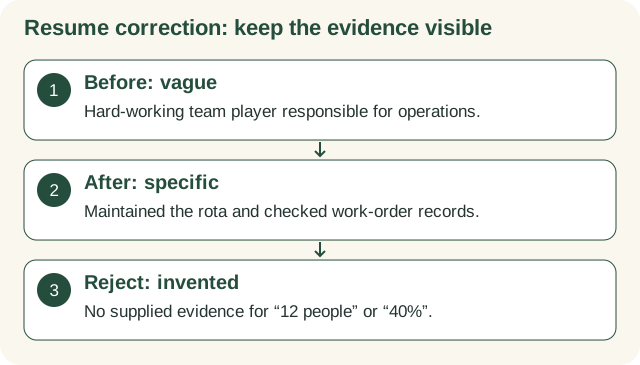
- Replace vague wording with specific work. Before: “Hard-working team player responsible for operations.” After: “Maintained the weekly service-team rota, checked work orders against booking records, and confirmed schedule changes with technicians.” This describes the fictional inputs without inventing impact or seniority.
- Check every added claim. An AI draft might say “Led a team of 12 and reduced errors 40%.” Neither fact was supplied. Remove both. Add a real count only if the candidate can explain its source and the work it describes.
- Check the submitted file. Open the actual exported document, copy its text into a plain-text editor and inspect headings, dates and bullets. This checks readable text extraction; it does not simulate every employer’s screening system or guarantee a score.
- Record the next review. Note the role, application date, change made and latest status. Keep pending applications out of a rejection count. Use a consistent follow-up window and compare similar roles before drawing conclusions.
| Requirement | True evidence in the fictional example | What stays unknown |
|---|---|---|
| Schedule service work | Maintained a weekly rota | Team size and quantified time saved |
| Keep records accurate | Checked orders against booking records | Error reduction percentage |
| Communicate changes | Confirmed changes with technicians | Any management responsibility |
A strong correction makes relevant experience visible. It does not turn missing experience into a keyword. For your own review, use the evidence builder to connect a claim to an actual example before updating the resume.
Try this AI prompt
Review my recent job-search activity, resume, and target roles: [paste]. Separate observations from possible explanations. Account for pending applications and small sample sizes. Identify three plausible bottlenecks, ask for missing information, and recommend one change to test over two weeks. Do not assume every rejection means my resume is poor.
Your next step
Review your last five suitable applications. Write one sentence describing the strongest evidence that you could do each job. If that sentence is difficult to write, begin with role selection. If it is easy but absent from your materials, begin with the application.
Keep practicing
- Work through a guided action plan
- Related prompt: Diagnose why a job search has stalled
- Download editable worksheets (PDF)
- Recommended tools: Organize your search