Career evidence
Make your portfolio evidence easy to find and verify
Use a simple AI-assisted review to improve the clarity of your portfolio, with honest evidence, readable project pages, and a recruiter-friendly next step.
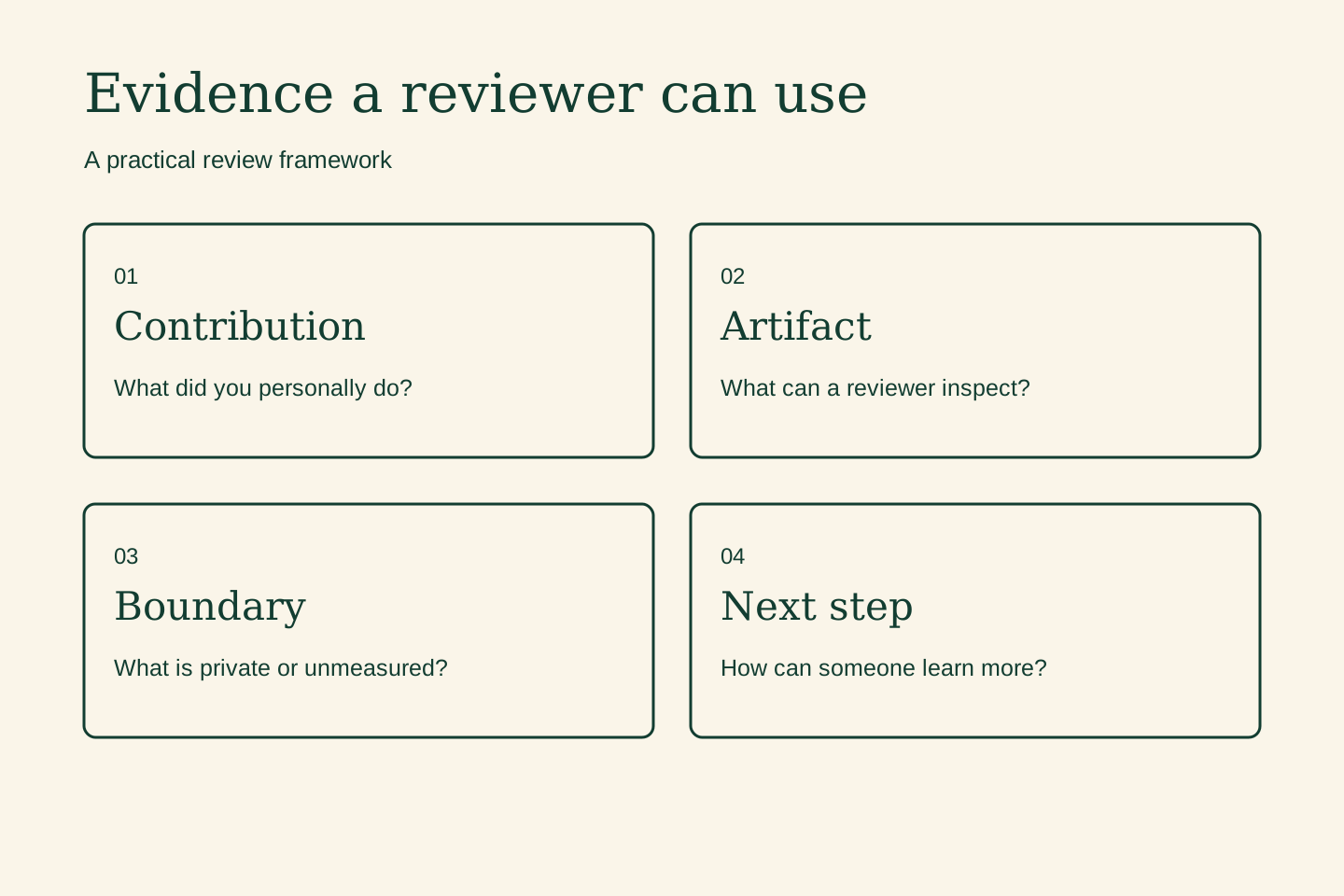
In this guide
The useful starting point
Build a clear account of the work you did, the decisions you made, and the evidence you can share. Use AI to identify ambiguity, then verify every suggested change yourself.
Treat discoverability as a clarity problem
It is tempting to imagine a hidden formula that makes every AI recruiter notice you. A more useful place to start is the page a real person can read today. Can someone identify your target work, understand your contribution, and verify a relevant example without opening six disconnected documents?
A public portfolio review is not an applicant-tracking-system test. Employers use different application processes, and this exercise cannot tell you how a particular employer screens candidates. Follow the actual application instructions. Use the portfolio to make your evidence easier to understand, not to promise a screening advantage.
Give one project a complete story
Choose a project relevant to the role you want. Write the problem, your responsibility, the constraints, the work you delivered, and what you learned. Separate your contribution from the team’s. If it was a practice project, say so near the title. If the result was not measured, describe what was produced and how you checked it.
Consider this illustrative revision: “Used AI to improve operations” becomes “Created a draft intake checklist for a fictional support team, reviewed ten invented requests, and revised two ambiguous routing rules.” The second version shows a bounded action and a review method. It does not pretend the project reduced a real company’s costs.
Add evidence beside the claim
Pair important statements with an artifact: a redacted process diagram, accessible prototype, short code sample, decision log, or permitted before-and-after excerpt. Explain what the reader should notice. A gallery of unexplained screenshots asks the reviewer to reconstruct your thinking.
Protect private work. Obtain permission before publishing employer or client material, and remove confidential details from any sample you share with an AI service. When permission is unavailable, make a clearly labeled independent demonstration using invented data. Keep dates, role titles, and achievements consistent with your résumé.
Run a constrained review prompt
Use the public page or a sanitized text copy. Try: “Using only this material, identify the work I am seeking, my personal contribution, the evidence supporting it, and the next step for a reviewer. Quote the sentence or link supporting each answer. Mark missing facts as unknown. Do not infer credentials, employers, results, or years of experience.”
Check the response against your page. If the assistant invents a result, remove the ambiguity that may have encouraged it and record the error. Its answer is feedback from one tool under one set of conditions, not a hiring verdict. Ask a trusted person to review the revised page too.
Remove friction from the reading journey
Use recognizable headings, readable text, descriptive link labels, and a clear contact route. Make the project understandable without relying on words embedded only in images. Test the page on a phone and open every artifact link in a signed-out browser. A permission error can hide your strongest example.
Let a reviewer see the essentials before downloading a file. Keep an accessible résumé version available when appropriate, and follow an employer’s requested format when applying. Avoid invisible keywords, copied job descriptions, or a list of tools unsupported by actual work.
Finish with one concrete improvement
Give yourself a manageable session: choose one project, rewrite its contribution paragraph, attach one appropriate artifact, and test the reading path. Ask a human reviewer to explain what you did without your help. Use any misunderstanding as the next edit.
Create a project brief in Proof Studio if you need a sample worth discussing. Then practice explaining your decisions. The strongest portfolio connects a clear claim to evidence you can confidently talk through.
Put one idea to work
Choose a task you understand, review the output, and record evidence of the contribution you made.
Try an AI-at-work playbook →Explore more from JobCoachGet new JobCoach guides in your inbox →Keep practicing
 Remote work & AI
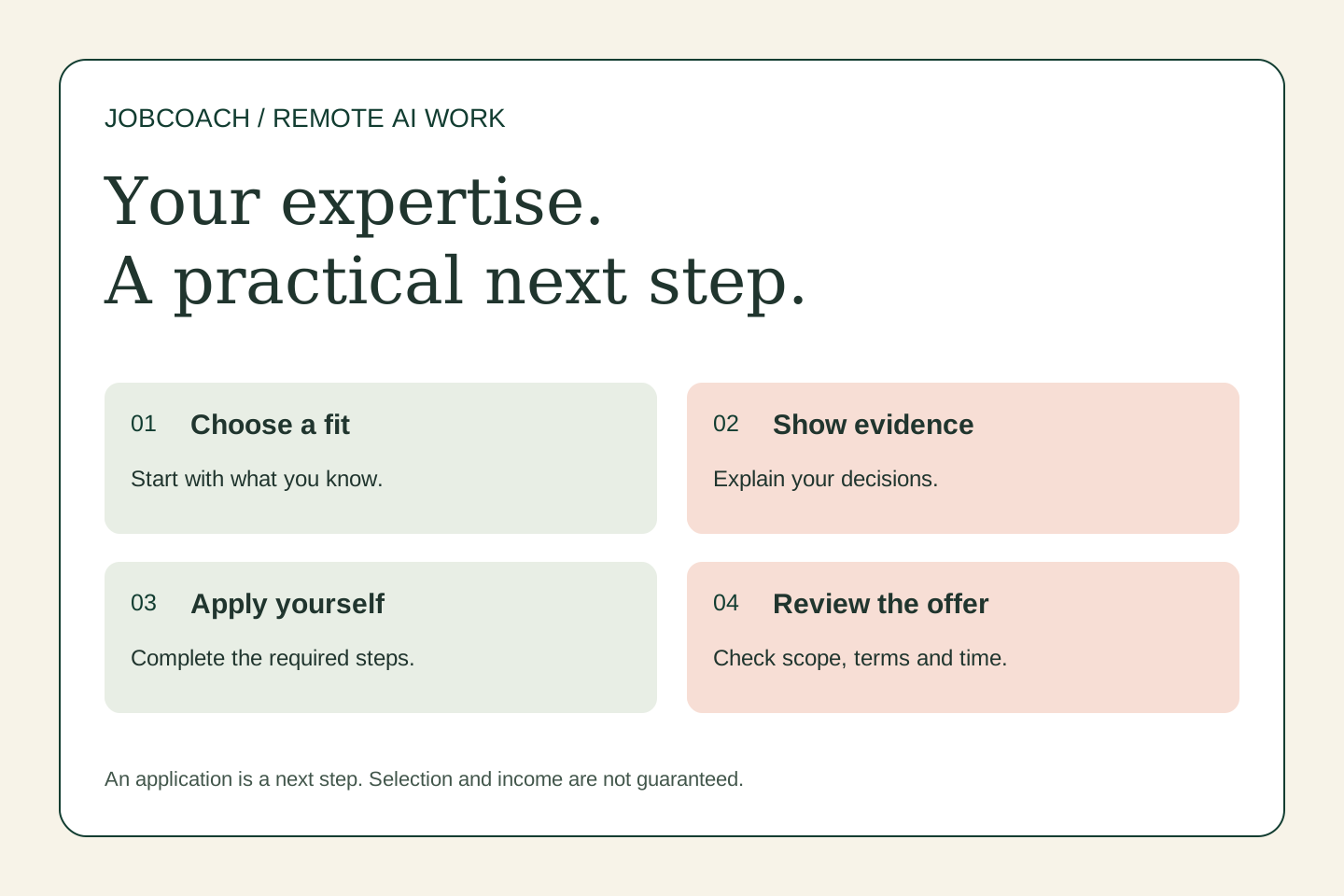
Applying to Mercor: a practical guide to remote AI contract work
Remote work is a location arrangement, not a promise of a steady job. Learn where Mercor fits, how to prepare a focused application, and what to check before accepting a project.
October 31, 2026 · 5 min read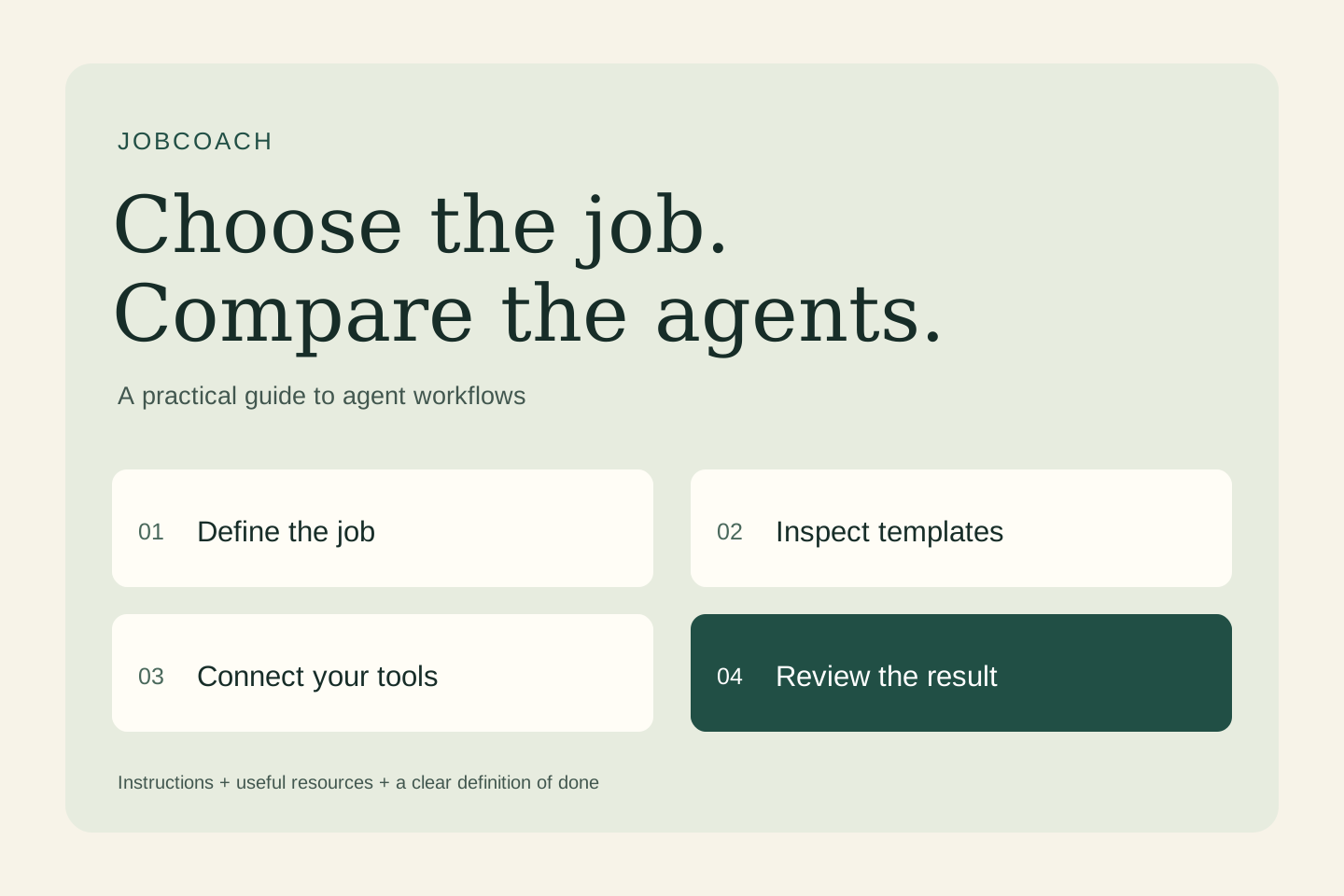 AI agents
Grok Bot for your job search: templates, Dots, Duet, and useful limits
How Grok Bot works, templates you can inspect, and a practical comparison with Dots, Claude Duet, Muse, Manus and Copilot Studio for an application preparation brief.
October 28, 2026 · 7 min read