AI & changing work
Which AI role fits you? Read the work behind the job title
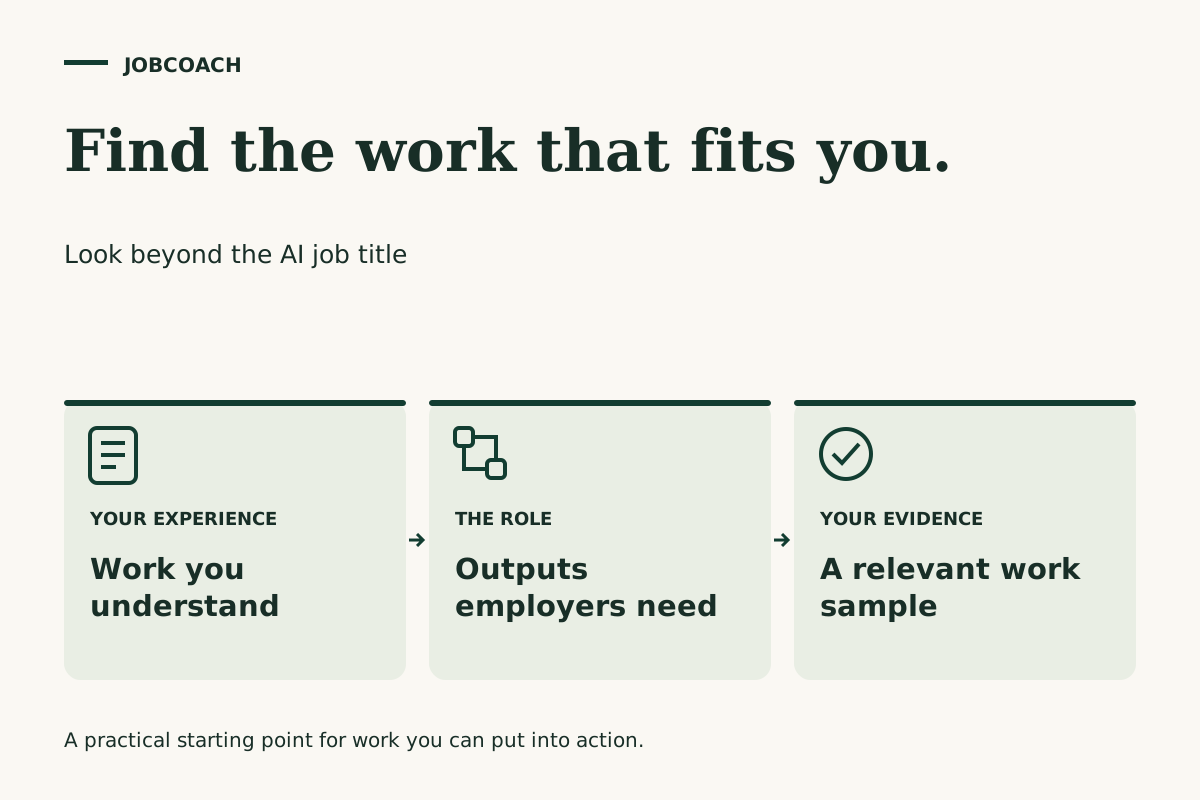
AI trainer. Experience designer. AI enablement specialist. The titles can sound unfamiliar even when part of the work is something you already do well. Use five role families to narrow your search, decode a job description, and choose a work sample that makes your fit easier to see.
In this guide
- The useful starting point
- A promising title is only the beginning
- Five role families to investigate
- Your four-step starting plan
- Decode one job description in four passes
- Worked example: from support lead to conversation quality
- Make your application about contribution
- Your next move this week
- Sources and further reading
The useful starting point
Start with work you already understand well.
A promising title is only the beginning
Indeed’s 2024 article prompted this practical look at changing work.
A title does not tell you whether a role involves software engineering, subject expertise, customer training, or repetitive rating tasks. Two employers can use the same title for very different jobs. Read the responsibilities, required qualifications, working arrangements, and assessment process before deciding whether to apply.
The World Economic Forum’s 2025 employer survey places analytical thinking and technological literacy among important workplace skills. That supports a useful search strategy: connect an existing strength to a concrete AI responsibility, then identify the additional skill the role actually requires.
| Role family | Experience to draw on | Useful proof piece |
|---|---|---|
| AI evaluation and quality | Quality assurance, editing, subject expertise | A scored set of responses with reasons |
| Conversation and experience design | UX, service design, customer support | A task flow with recovery and human handoff |
| AI enablement and instruction | Teaching, onboarding, team coaching | A short lesson and learner practice task |
| Knowledge and content operations | Documentation, research, content management | A cleaned knowledge pack with source ownership |
| Workflow implementation | Operations, systems analysis, development | A tested workflow with a clear exception path |
Five role families to investigate
Start with the table below. These are search directions and portfolio suggestions, not a list of available vacancies. Your best match is the family where you can already explain what a good result looks like.
Customer-service experience may transfer to reviewing assistant responses. Teaching experience may transfer to helping colleagues adopt a workflow. Editing experience may transfer to improving AI-assisted content. Technical model development and production engineering require additional depth; do not treat familiarity with a chatbot as equivalent experience.
Your four-step starting plan
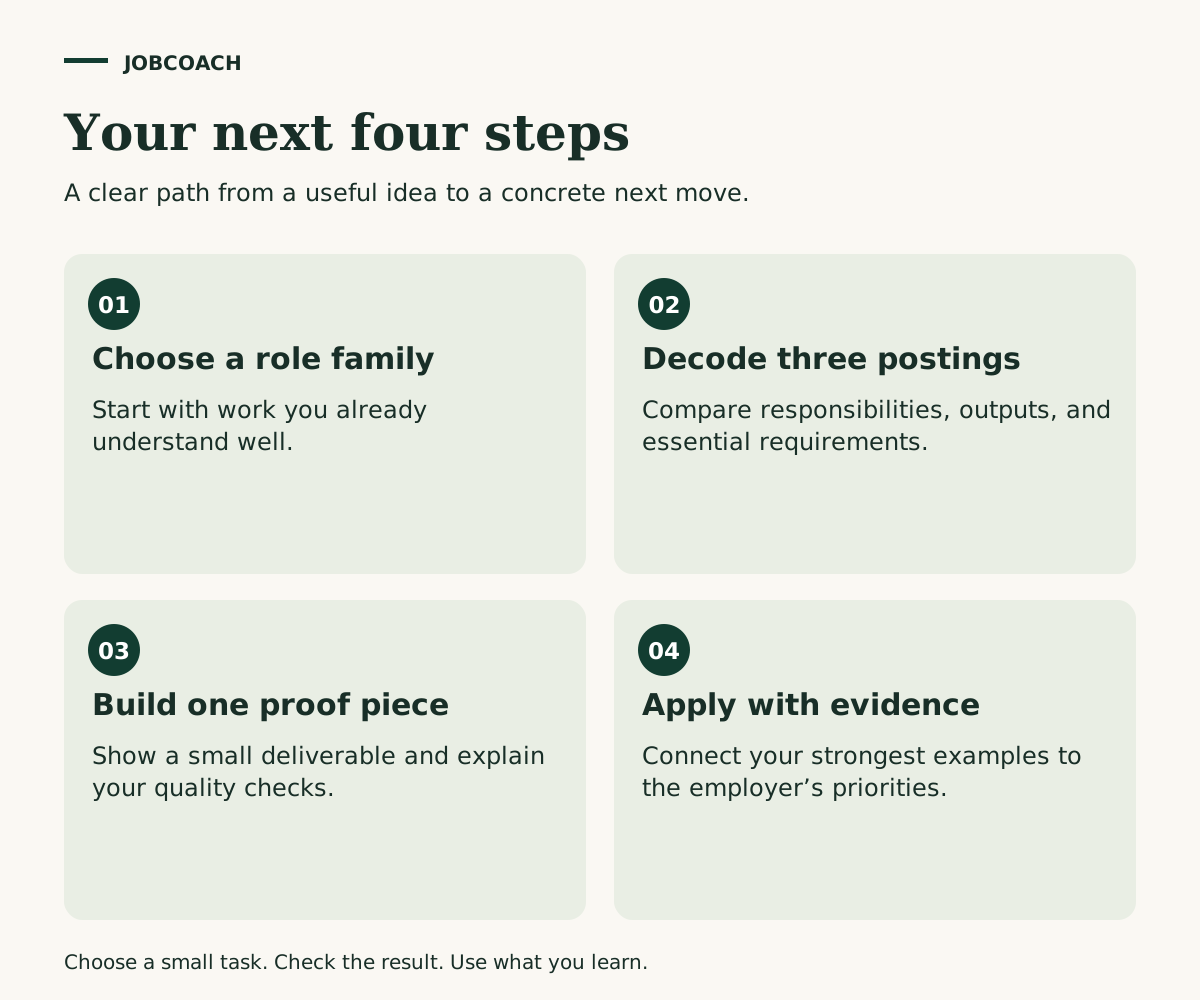
- Choose a role family
Start with work you already understand well.
- Decode three postings
Compare responsibilities, outputs, and essential requirements.
- Build one proof piece
Show a small deliverable and explain your quality checks.
- Apply with evidence
Connect your strongest examples to the employer’s priorities.
Decode one job description in four passes
First, highlight the verbs: evaluate, design, facilitate, integrate, monitor, or troubleshoot. Next, identify the outputs: a scored dataset, conversation flow, training session, working integration, or quality report. Then separate essential requirements from preferences. Finally, find the conditions: location, hours, employment type, data access, and who accepts the work.
For each major responsibility, write one of three notes: I can show this; I have related experience; I need to learn this. Attach an example to the first two. This turns a vague confidence problem into a much smaller evidence problem.
When a posting says ‘build AI workflows,’ investigate what build means. It might mean configuring a no-code tool, writing integration code, or documenting a manual process. Ask for an example of a successful first-month deliverable before assuming those are interchangeable.
Worked example: from support lead to conversation quality
Imagine a support team lead considering a role that evaluates customer-facing AI replies. Her relevant experience is recognizing incomplete answers, resolving escalations, and coaching agents on tone. Her gap is explaining a repeatable evaluation method.
For a practice project, she writes ten customer questions against a short policy she created herself. She produces example replies, checks each against the policy, and records accuracy, completeness, tone, and whether a human handoff is needed. She includes a question with missing information and one requesting an exception.
Her portfolio shows the policy, scoring guide, two before-and-after replies, and her reasons for each decision. In an interview, she can explain what the system should do when it cannot answer. That is more specific than saying she is ‘passionate about AI.’
Make your application about contribution
Choose two or three responsibilities that matter most to the employer. Put the relevant evidence near the top of your resume or portfolio. Describe the problem, your role, the decision you made, and the result you can support. Use actual measurements when you have them; describe the deliverable and review process when you do not.
A useful interview question is: ‘What would excellent work in this role look like after the first 60 days?’ Follow with questions about quality standards, team support, and how performance is assessed. You are evaluating whether the role fits your strengths and working preferences, too.
Your next move this week
Choose one role family and review three current postings directly on employer career pages. Save the recurring responsibilities, select one gap you can reasonably work on, and create one focused sample. Keep the scope small enough to finish and explain.
If you want help connecting your experience to a realistic target, explore Career Momentum. Bring a posting and your current resume; use the conversation to identify the strongest evidence and the next useful step.
Sources and further reading
- Indeed: Future-Proofing Your Workforce (updated October 31, 2024)
- World Economic Forum: Future of Jobs Report 2025, Skills Outlook
Sources checked November 11, 2026. Review the linked publisher information for current details.
Put one idea to work
Turn your experience into a focused search and a stronger story for the work you want next.
Explore Career Momentum →Explore more from JobCoachGet new JobCoach guides in your inbox →Keep practicing
 Technology field notes
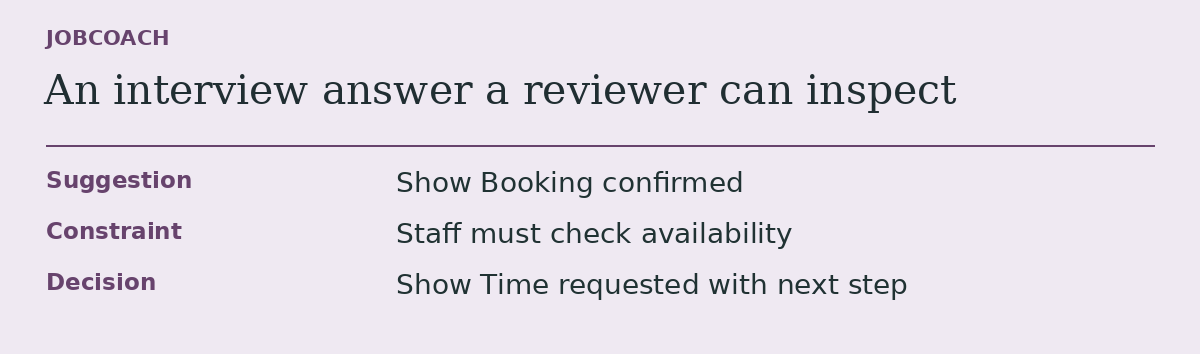
Turn an AI-assisted portfolio project into an interview you can defend
Use a decision, a rejected suggestion and a piece of evidence to tell the story of your contribution.
November 18, 2026 · 2 min read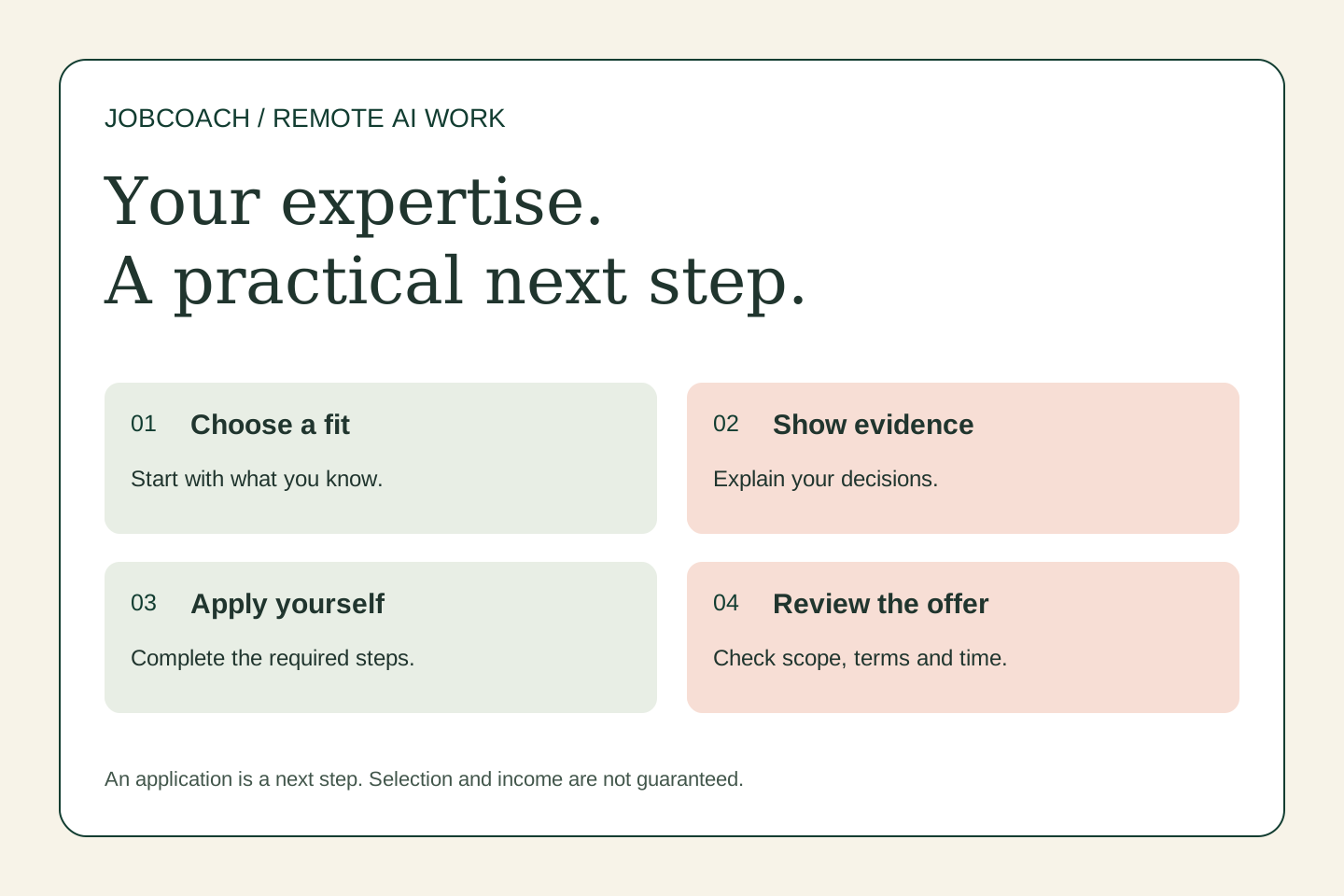 Remote work & AI
Applying to Mercor: a practical guide to remote AI contract work
Remote work is a location arrangement, not a promise of a steady job. Learn where Mercor fits, how to prepare a focused application, and what to check before accepting a project.
October 31, 2026 · 5 min read